
The man, the myths, and the making of the pot pourri that is Mumbai
In her book 'Sea, Salt & Spice' Meher Mirza takes the reader on a culinary history of Mumbai as trade and culture jostled in this vibrant port city to create its unique identity. But where did the city's story begin? An excerpt.
By MEHER MIRZA
Mumbai, August 2026
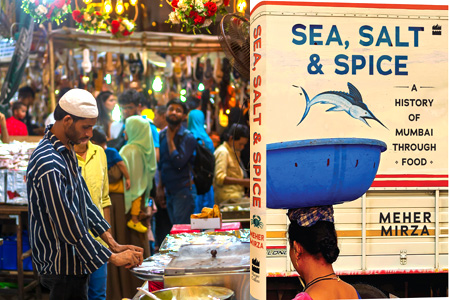
Author and travel journalist Meher Mirza dives into a whimsical history of Mumbai through food in her new book: 'Sea, Salt & Spice'
THE tale of South Mumbai’s first immigrants opened circa 1290 ce, when a new king rose in the west – the powerful Bimba or Bhimadev.* The
medieval text Bimbakhyana (a part of the Mahikavatichi Bakhar) was named after King Bimba himself, and for a long time was the only proper record we had of him. In Bimba’s eyes, Mumbai fizzed with possibilities. He found
Koli villages spread over the coast, the ancient temples of Walkeshwar and Mumbadevi, swathes of babul and palm trees, rich agricultural lands – in short, a land ripe for conquest.
Soon, he would stake his claim on the Mahim (Mahikavati) of today, making it his capital; he was perhaps responsible for the earliest iteration of the Mahim Fort, easily the oldest existing fort in Mumbai.

Meher Mirza
The Bimbakhyana tells us that the soil of the area was so fertile that even the fiercest warrior could lay down his arms and take up agriculture. The jobs for men largely fell within the spheres of polity and administration, or farming
Early immigrants
The Son Kolis (fisherfolk), Warlis and Mumbai’s other indigenous
inhabitants made up much of the existing population at the time. Bimba brought with him a straggle of immigrants. ‘Among the sixty-six families’ who followed him to Mahim, writes Shanta Gokhale in her book Shivaji Park, ‘there were twenty-seven Somvanshis, twelve Suryavanshis, nine Sheshvanshis, Panchals,
Kunbis and Agris’. It is said that the Agri community’s livelihood came largely from salt farming. Meanwhile, ‘the Bhandaris, with Vadvals and Malis who came at this time, initiated cultivation introducing various fruit and flower bearing plants that have lent their names to portions of modern Bombay’, write A.D. Pusalkar and V.G. Dighe.
Soon, immense columns of coconut, mango and other fruit plantations sprang up, palaces and temples and homes were erected, and dharmshalas hurriedly built. There were elephant stables in Matunga, a court in Naigaon, salt flats in Khar, toddy tappers, apta trees in Malvan, a thriving equine centre in Ghodbunder.
Clearly, Bimba was Mumbai’s star and naturally, stories of his kingship entered into the Mahikavatichi Bakhar.
The 'first benefactor'
The Bimbakhyana tells us that the soil of the area was so fertile that even the fiercest warrior could lay down his arms and take up agriculture. The jobs for men largely fell within the spheres of polity and administration, or farming. No wonder, then, that writers such as Gerson da Cunha call him the ‘first benefactor of our island and [that] it is incumbent on us residents here, in token of our gratitude, to cherish his blessed memory’. According to da Cunha, Bimba was the reason the Portuguese knew of Bombay as a ilha de boa vida, or the island of the good life, ‘for Bhima’s plantations, groves, gardens and houses had indeed made it a place of recreation and amusement’.
Historians and city chroniclers have written rather floridly about King Bimba’s memorial where, apparently, people have made sacrifices up until the twentieth century. ‘In the oart* called the Bhim Raja’s oart or Arshe Mahal [possibly in Naigaon],’ writes Stephen Meredith Edwardes in the year 1902, ‘he is represented by a black stone besmeared with red paint and flowers, and the descendants of his followers, especially the old Bhoirs and Thakurs, make homage to this stone by worshipping it with flowers, milk, clarified butter, etc. and offering not only fruits, but also goats and fowl. Till recently, an annual jatra or fair used to be held in his honour, when animals were sacrificed; but the new Maharaja owner of this oart, being a strict Vaishnav, has put a stop to this, and he has advised the people to feed Brahmans [an injunction that overlaid the indigenous practice of offering animal sacrifices], for the pacification of the spirit of Bhima Raja, who is said to haunt, or as the people say, keep a watch over the place of his past glory.’
Soon, immense columns of coconut, mango and other fruit plantations sprang up, palaces and temples and homes were erected, and dharmshalas hurriedly built. There were elephant stables in Matunga, a court in Naigaon...
Many of the place names of that time are still in use today – Kanjur, Kalina, Dahisar, Khar, Danda, Dharavi, Sewri, Marol, Madh and Malvan amongst others, many of which were home to communities such as the Warlis and the Kolis, of course, but also the Mangele, Thakar, Katvadi and others. Many localities grew their names from their agricultural taproots – Borivali (from the bor fruit), Kandivali (from the mangroves), Bhaikhale (khale meaning farm), and so on.
Or did a goddess come first?
Popular opinion chivvies us into believing that Mumbai came from Mumbadevi, the goddess of the Kolis, which is certainly true. (Similarly, the Koli goddess Kalubadevi gave the name to Kalbadevi, and Colaba came possibly from Koli.) But Bimba’s Mahim was also once known as Bimbasthan, as a thirteenth-century shasanapatra or government notice says, and the name Mumbai could have evolved from that as well.
History muddies a little here, but we are told that the demise of the dynasty of Bimba came when the Delhi Sultanate, helmed by Alauddin Khilji, wrested control of Mahim (around 1318 ce). Naturally, power changed hands and old alliances teeter-tottered; erstwhile independent kings of the Konkan area began to accept the supremacy of the Sultanate.
Around this time, many local kings became rulers of the region, including the powerful Koli general Jayaba Mukne, who captured the fort of Jawhar and was awarded the title of Nimsha, or ruler, by Muhammad bin Tughluq, eighteenth ruler of the Delhi Sultanate.
North Konkan also saw the star of the potentate King Hambirarao (around 1365 ce) shine bright. An independent king without affiliations to any existing dynasty, he ruled over a vast swathe of land from Thane to Murud, and like Bimba before him, he too made Mahim his capital. Also possibly a vassal of Tughluq, he built a thriving kingdom on the revenue gathered from the trading hubs of Thane and Chaul.
And around 1394, Alunaka Rana, also called Alu Nakhava, a Koli king from the Naitya or Nawait community who likely had Arab ancestry, took advantage of the now weakening Delhi Sultanate of which he was a vassal, and declared himself an independent king – a 1396 inscription found in Dombivali calls him ‘Maharajadhiraja’. His reign saw the local fishing, salt farming and boatmen communities grow more prosperous and politically stronger, while indigenous goddesses such as Mumbadevi were even more widely embraced than before. The Koli kings who came after him sadly saw their kingdom toppled by the treacherous Durgadevi famine. And so it was that Muzaffar Shah, sensing a weakening of the regime, took control and seeded the Gujarat Sultanate in the Konkan region.
Up until the sixteenth century, when the Portuguese snatched power, Mumbai remained an important trade partner with West Asia (the Persian Gulf and ports of the Red Sea), and Thane and Mahim remained trading strongholds. Expectedly, the Deccan grew thick with Sufi shrines, beacons that served as trading posts, as well as hostelries for weary, hungry travellers. This is also when Makhdoom Ali Mahimi’s dargah, one of the city’s oldest shrines, was founded. We know from the fifteenth- and sixteenth-century writings of navigators Ibn Majid and Sulaiman al-Mahri that Mahim was a big draw for the ships of Omani, Iranian and Arab traders.
_______________________
HarperCollins India is the publisher of this 'definitive' culinary biography of Mumbai by food and travel writer, Meher Mirza – Sea, Salt and Spice: A History of Mumbai Through Food. Talking about the book, Meher Mirza says, ‘I wrote this book to answer the big questions of life. Questions about the Mumbai mango – was it really the best in India? Were Parsis really the biggest protesters against Prohibition? Did Mumbai really boast of a cabaret dance routine called Turkish Coffee? Was vegan ice-cream really invented in colonial Bombay? As I said, crucial, earth-shattering questions. Along the way, I’ve dug coffin-deep in the archives to write about everything from the ‘halcyon’ precolonial days, onwards to Portuguese and British colonialism, to this millennium.’
In Sea, Salt and Spice, noted food-and-travel writer Meher Mirza traces the history of this great metropolis through what was cooked, preserved, traded and eaten – from Koli kitchens and Peshwa courts to Portuguese enclaves and British colonial ports, all the way to the sleepless streets of present-day Mumbai.
Post a comment
- HOME
- BUSINESS
- DEVELOPMENT
- ENERGY
- ENVIRONMENT
- HEALTH
- INFORMATION
- POLITICS
- SECURITY
- SHIPPING
- SOCIETY
- TRAVEL
- TRENDS
Iran war causing chaos not change
Iran war and Gaza attacks have caused chaos, hunger, refugees, and new vendettas. Where does this lead? See world opinion
Once in a babymoon
Daft terms are counfounding travellers and mangling the English language ... more…
