
Why Hong Kong needs better
English to engage the world
From election manifestoes to student aptitude tests, English appears to be getting short shrift. This could profoundly impact business in this ‘World City’.
By VIJAY VERGHESE
Hong Kong, December 2025
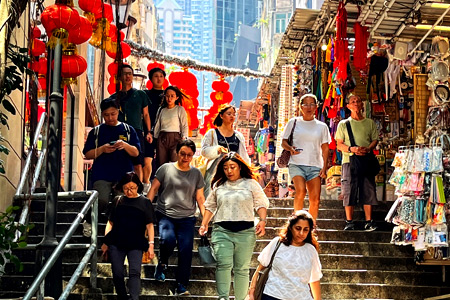
Hong Kong's Pottinger Street: the city's diverse population requires a polyglot culture and better English proficiency to regain a seat at the global business high table/ photo: Vijay Verghese
IN Hong Kong these days you’re more likely to hear the soft cadences of Putonghua in the streets rather than the staccato Cantonese of yore. Of course Cantonese is spoken by a majority, but an influx of 150 Mainlanders per day on one-way permits is slowly shifting the linguistic balance. What is not heard that commonly, is English. And therein lies the rub.
Hong Kong ‘World City’ is the official conduit for international funds flowing into China. The city’s global outreach, laissez-faire appeal, and sophisticated precedent-based common law — the only such jurisdiction in China — have attracted entrepreneurs and investors for years. And its independent membership of over 50 international organisations like the World Trade Organisation, gives the enclave unique agency to steer its course. Article 8 of the Basic Law of the HKSAR clearly states: “…common law, rules of equity, ordinances, subordinate legislation and customary law shall be maintained.” Business reassurance is grounded in this.
English, the lingua franca of commerce
Business also needs English, the lingua franca of global commerce. The departure of many English speaking business elite and sudden emigration outflows post 1997 revealed glaring shortcomings in the territory’s language capabilities. Caught up in post-handover patriotic fervour, this issue has remained largely unaddressed. Is English getting short shrift?

Vijay Verghese
Boilerplate politicking and a casual dismissal of English shows that many candidates may not fully appreciate their city’s key role in the global financial firmament.
The December elections for the Hong Kong Legislative Council brought this issue once again into stark relief. The South China Morning Post reported that of the 161 candidates it surveyed, just 38 had manifestoes in English. This immediately lends itself to the interpretation that English has no relevance in the territory. This is far from the truth. English is key to robust global engagement along with Putonghua and Cantonese that provide leverage in China as its strategic centrepiece — the Guangdong-Hong Kong-Macao Greater Bay Area — builds cutting-edge hi-tech clout using innovation and green development.
Boilerplate politicking and a casual dismissal of English shows that many candidates may not fully appreciate their city’s role in the financial firmament. Lack of English outreach has raised concern, and rightly, over the seeming disenfranchisement of ethnic minorities. But the real problem is the diminished attention to the international business community in Hong Kong and overseas, which is seeking to understand the political dynamics of the city.
HK lags behind Singapore
In 2024 an Education Bureau annual assessment revealed just 67 percent of Secondary Three students (15-year-olds) had basic competency in English, the lowest level since 2006, a drop attributed to Covid. Singapore, which has made English its official language, ranks highest on English proficiency in Asia followed by the Philippines, Malaysia, and then Hong Kong in fourth place.
It is worth recalling how in 1978 China Premier Deng Xiaoping made a dramatic decision to send 3,000 students abroad each year to gain the critical scientific knowledge needed to propel the country forward after the ravages of the Cultural Revolution. At the time, scientific and academic research papers were almost entirely in English. The experiment worked. The results of that massive knowledge transfer and the studious adoption of English are evident in China today.
An imported can-do spirit
Some amount of English is slowly percolating back into Hong Kong with the arrival of young Mainland emigres though of course a preference for Putonghua is clear. But with them has come a resurgence in the city’s fading can-do attitude. That problem-solving energy dissipated after the 2019-2020 protests as many youth retreated to their homes to ‘lie flat’ — a term that has come to exemplify a minimum work regimen as a mark of despair or silent protest.
Human capital is a city’s biggest asset and it does not help that so many prefer to stay unproductive at home. Hong Kong needs to focus on re-energising these forgotten youth
A late 2024 survey of 990 secondary students by the Hong Kong Young Women’s Christian Association revealed that 27 percent of respondents perceived themselves as ‘lying flat’, translated as, “Not wanting to do homework or socialise, not aiming for good results in their studies, lacking specific targets or interests, having no aspirations for the future and wanting to live a relaxed life”.
Human capital is a city’s biggest asset and it does not help that so many prefer to stay unproductive at home. Hong Kong needs to focus on re-energising these forgotten youth. Along with them, ethnic minorities need to be brought into the mainstream to visualise and work towards a rewarding common future.
Hong Kong must focus on local issues, be it housing, education, jobs, re-training and upskilling, health, institutions, tourism, language policy, the youth and an ageing population. This needs some clear-eyed thinking well beyond the banal "optimising transport", "path forward for the middle class", and "proud community", that dominates pamphlets mailed out by candidates for the Hong Kong Island and East Geographical Constituency. Just one, sensibly included "youth upward mobility" options for the "lie-flat" generation, along with suggestions for the elderly and revitalising struggling SMEs.
The city must remain different
More broadly, there are nationwide imperatives and the city must play its part in China’s strategic blueprints but the real benefit to Beijing lies in Hong Kong’s differentiation from other cities in China. As a financial powerhouse Hong Kong can be its champion on the international stage. But to do so, requires an outward-looking and open-minded education policy, a far better grasp of English, and a formulation of fresh inclusive ideas for growth. Hong Kong must do what it has always done best. Think Big. And Innovate. It certainly Can-do.
Vijay Verghese started out as a reporter for the Times of India, a national daily, in 1979. He moved to Bangkok and thence to Hong Kong in 1984 as editor and publisher of a range of news, business, travel and lifestyle publications including Business Traveller, HOLIDAY Asia, and Asian Business. He launched Dancing Wolf Media in 2002 and runs the online magazines SmartTravelAsia.com and AsianConversations.com when not dabbling in avatars, music and virtual guff.
Post a comment
- HOME
- BUSINESS
- DEVELOPMENT
- ENERGY
- ENVIRONMENT
- HEALTH
- INFORMATION
- POLITICS
- SECURITY
- SHIPPING
- SOCIETY
- TRAVEL
- TRENDS
Iran war causing chaos not change
Iran war and Gaza attacks have caused chaos, hunger, refugees, and new vendettas. Where does this lead? See world opinion
Once in a babymoon
Daft terms are counfounding travellers and mangling the English language ... more…
